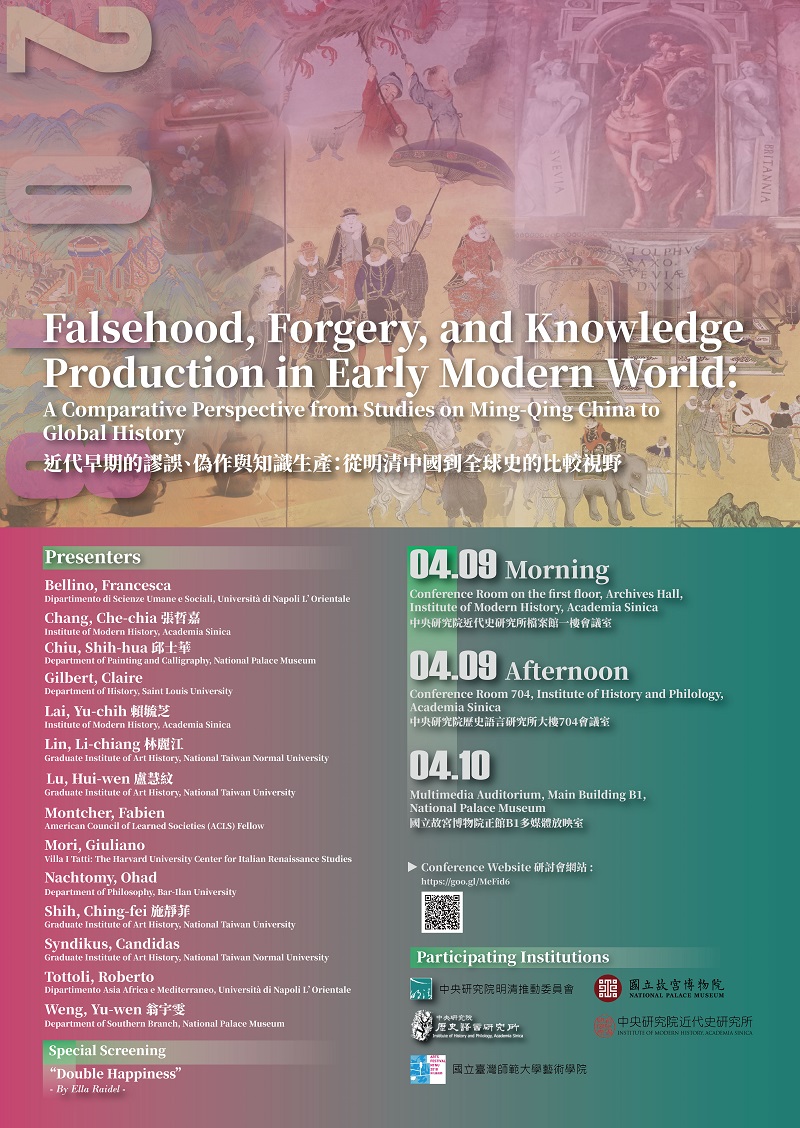
nternational Conference on “Falsehood, Forgery, and Knowledge Production in Early Modern World: A Comparative Perspective from Studies on Ming-Qing China to Global History”
April 9-10, 2018, sponsored by Institute of Modern History, Academia Sinica; Institute of History and Philology, Academia Sinica; National Palace Museum; Institute of Art History, National Taiwan Normal University
This international conference was jointly sponsored by Academia Sinica’s Institute of Modern History and Institute of History and Philology, the National Palace Museum, and National Taiwan Normal University. This pioneering event examined falsified and fabricated materials not simply as distortions of truth but as dynamic agents in knowledge formation and cultural exchange. By convening scholars of Chinese, European, and Islamic worlds, it fostered genuinely comparative dialogue across disciplines and regions, revealing how forgeries and replicas actively shaped global knowledge networks in the early modern era. Many of the distinguished participants were leading figures I first connected with during my fellowship at the Institute for Advanced Study, Princeton. Among them was Professor Roberto Tottoli, a world authority on Qur’anic studies and recipient of the prestigious 2015 Custodian of the Two Holy Mosques International Award for Translation.

The workshop was featured in the Ming-Qing Studies Newsletter of the Committee for Promotion of Ming-Qing Studies, Academia Sinica, which published a detailed report highlighting its significance and outcomes.
